Shindo
Hand-built tube amplifiers voiced for musical truth.
Ken Shindo · Japan (Tokyo) · Boutique
- Design: Each circuit designed around its chosen NOS tubes — the design serves the parts, not the other way around.
- Tendency: Dense, harmonically alive, flowing — music sounds physically present.
- Trade-off: Tonal saturation and musical naturalness over transient precision and measured linearity.
Philosophy
Shindo Laboratory designs tube amplifiers around musical naturalness rather than measured specification. Each circuit is designed individually to exploit the sonic character of its chosen NOS tubes — the design serves the parts, not the other way around. The Western-Electric tradition of circuit individuality carried forward as new equipment rather than curated as memorabilia.
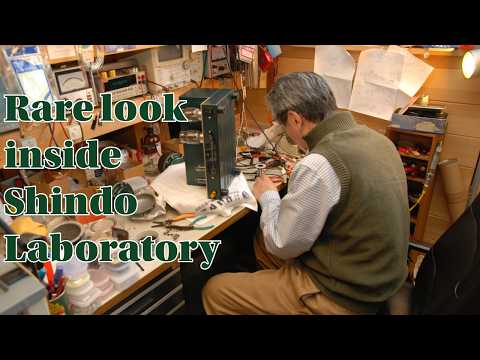
Ken Shindo started his career as an electrical engineer at Matsushita before founding Shindo Laboratory in Tokyo in 1977. He was a noted collector of new-old-stock vacuum tubes and vintage components, and designed each amplifier as a unique circuit suited to a specific set of parts, a specific kind of system, and a specific musical mood. There are no stock circuits in any Shindo product. The goal was never to build a technically optimal machine — it was to let reproduced music sing with the organic quality of a live performance, with the chosen tube and the chosen circuit acting as an inseparable pair rather than as interchangeable parts.
Leadership & Origin
Ken Shindo (1939–2014) founded Shindo Laboratory in Tokyo in 1977 after working as an electrical engineer at Matsushita — at a moment when the Japanese hi-fi industry was standardising around solid-state product and treating the post-Western-Electric tube tradition as territory for vintage gear or expensive imports. Shindo's argument was that the WE tradition of circuit individuality — each amplifier designed around a specific set of NOS components, hand-wound transformers, and a specific musical mood — could be carried forward as new equipment, not curated as memorabilia. He built every amplifier by hand using point-to-point wiring; production was deliberately limited to roughly 50 units per year globally. After his passing in 2014, production continues under his trained associates, maintaining his methods and sonic philosophy.
Sonic Character
Listeners consistently describe Shindo amplifiers as dense, flowing, and harmonically alive — physical instrumental presence and harmonic realism rather than spec-sheet neutrality. The brand is closely associated with vintage-horn, single-driver, and high-efficiency speaker culture, and with the analogue (LP / tape) front end as the natural source.
Listen / Watch
Strengths
- The Western-Electric circuit-individuality tradition carried forward as new equipment — each amplifier designed around a specific set of NOS components, hand-wound transformers, and a specific musical mood rather than around a stock topology
- Harmonic richness and tonal density treated as the foundation of the voicing, not as additive flavour — the resulting sound has been the reference point for the broader tube-musicality school for two decades
- Hand-built craft expressed at the brand scale: ~50 units per year globally, every amplifier by hand under continuous design-school stewardship since 1977
- Midrange presence and vocal naturalness so distinctive that "the Shindo sound" has become editorial shorthand — the voicing is recognisable across the line, not just within individual models
- Deep synergy with high-efficiency speakers (DeVore Orangutan, Altec horns, Klipsch Heritage) and analogue front ends — Shindo + high-sensitivity speakers is one of the most-celebrated systemic pairings in modern audio
Trade-offs
- Production deliberately limited to ~50 units per year globally — the idea does not scale to broad availability; ownership requires patience, and pricing reflects the constraint
- Low output power requires high-sensitivity speakers (90 dB+) — the idea forecloses pairing with the standard mid-power solid-state loudspeaker market
- Bass authority and dynamic headroom are deprioritised relative to high-power solid-state — Shindo gives up slam for tonal density and harmonic presence
- Vintage NOS tube and component dependency is part of the design philosophy but also a real ownership cost — supply matters over the lifecycle of the equipment
Pairing Guidance
Shindo amplifiers are designed for high-efficiency speakers that work with lower power output. The combination of Shindo electronics with high-sensitivity speakers is one of the most celebrated systemic pairings in modern audio — deeply identified with vintage horn, single-driver, and Musical-Communication-school enthusiasts.
Shindo pairs naturally with brands and components whose ideas align: musical communication over measured neutrality, circuit individuality over standardised topology, the analogue front end over the digital as the primary source, high-sensitivity speakers over the mid-power solid-state mainstream. The canonical Shindo system is the most-celebrated systemic pairing in modern high-efficiency audio: Shindo electronics into DeVore Orangutan, Altec-based horns, Living Voice, or Klipsch Heritage speakers, with an analogue source (LP via low-output MC cartridge → SUT → Shindo phono stage) feeding the chain. Other natural partners share the orientation: Auditorium 23 cables and SUTs (analog-interface coherence), Leben CS600X (Japanese-artisan tube voicing at lower cost), Aurorasound phono stages (low-noise transparency that does not edit the tonal palette), TotalDAC for the rare cases where a digital source enters the chain. The Shindo preamp — Aurièges, Monbrison, or Masseto — is the system anchor: the preamp typically defines the Shindo system sound more than the power amplifier, which makes preamp selection the most consequential decision in building a Shindo chain. Anti-pairings reveal the trade-off: high-feedback solid state, low-sensitivity speakers (below 88 dB), measurement-led front ends, and FPGA DACs that prioritise transient surgery over tonal weight will fight rather than partner the Shindo voicing.
Design Families
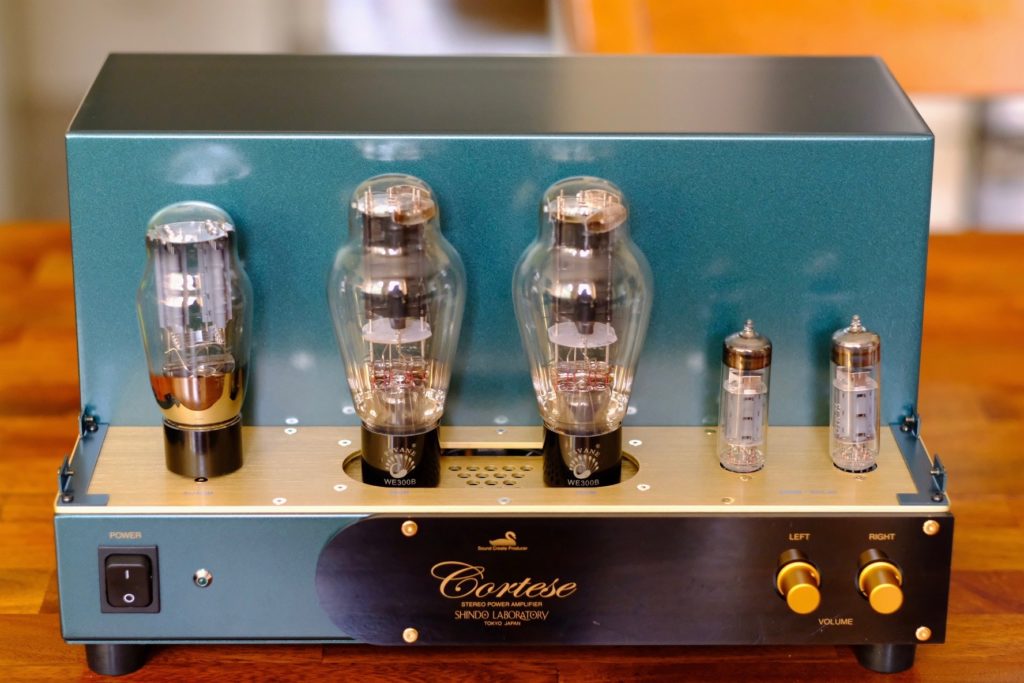
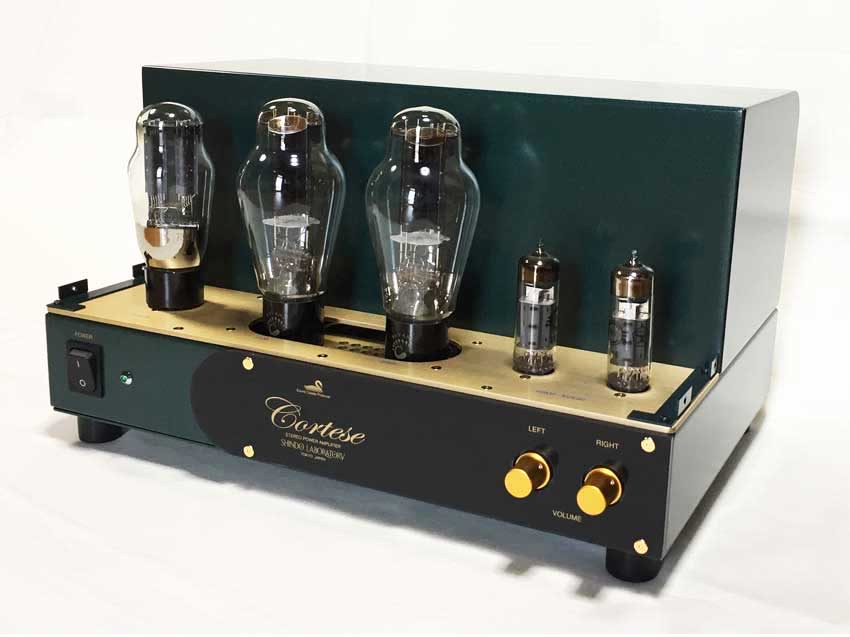
Single-ended stereo power amplifier series, voiced for low-power directness and harmonic presence. The Cortese F2a (~10W) re-purposes a Telefunken pentode for single-ended audio amplification; the Cortese 300B uses the canonical single-ended triode tube. Both are the most-cited expressions of the Shindo psychedelic-presence voicing and the entry point to the line.
Pairing: Requires 90 dB+ speakers. Canonical with DeVore O/96, Altec horns, Living Voice. Insufficient power for typical 86–88 dB stand-mount monitors.
Push-pull designs with more power (15–25W) and a richer tonal palette than the single-ended Cortese. Greater dynamic headroom and broader speaker-pairing latitude while preserving the Shindo voicing. The model names follow Shindo's wine-naming tradition.
Pairing: Works with 88 dB+ speakers. Pairs with high-efficiency speakers that benefit from more grip than single-ended designs deliver, and with vintage horns that want slightly more bass authority than the Cortese provides.
System anchors — each voiced with a distinct character within the Shindo voicing tradition. The preamp typically defines the Shindo system sound more than the power amplifier, which makes preamp selection the most consequential decision in building a Shindo chain.
Pairing: Aurièges as the entry point; Monbrison in the middle tier; Masseto at the reference. Each pairs naturally with Shindo power amplifiers; mixing Shindo preamps with non-Shindo power amps is possible but typically compromises the chain coherence the brand is designed around.